
How Independent Pharmacies Can Grow Revenue With Workplace Vaccination Clinics
A workplace vaccination clinic brings together two opportunities: helping more people get vaccinated and building a repeatable service for the pharmacy. Instead of waiting for employees to arrange separate trips to the store, your team brings the service to a place they already go.
The business works when you connect four things:
- Reach: new patients and a host who helps employees register and attend.
- Efficiency: a prepared team serving scheduled groups with fewer administrative interruptions.
- Collections: accurate records, the right billing route and follow-up through payment.
- Repeat business: a good event that earns the next invitation and introductions to other workplaces.
Get those pieces right and the clinic can serve more patients while sharing travel, setup and coordination across the session. Do them inconsistently and a busy room can still produce a poor return.

1. Find a workplace that will help people attend
A workplace gives your pharmacy access to people you would otherwise need to reach individually. The employer can share an invitation, provide space and arrange time for employees to participate. Your team supplies the clinical service.
Start with employers where you already have a relationship, including businesses whose staff use the pharmacy. Look for a coordinator who will actively organize attendance. A flyer in a break room is useful, but a coordinator who helps different shifts register and attend creates a much stronger opportunity.
Before agreeing to a date, establish:
- Who you will serve: the workforce, the vaccination offered and the patients your team can appropriately vaccinate.
- How people will attend: the invitation, registration link and time away from work, including production-floor and evening-shift employees.
- Where the clinic will run: a suitable arrival point, private clinical space and observation seating away from busy work areas.
These details are commercial as well as practical. A venue with engaged coordination and workable appointment times gives the pharmacy a better chance of completing the session it has staffed.
Introduce the pharmacy to new patients. Employees also meet a local pharmacy team they can contact afterward. Tell them where to find you for other care they need, without turning the visit into a sales pitch. Later business is a separate benefit; the clinic should make sense on the work you are going there to perform.
2. Decide whether the clinic is worth staffing
A busy clinic and a worthwhile clinic are not the same thing. Review expected attendance, the payment arrangement and the full work involved before committing the team.
Settle who pays before you promote the event
| Decision | Employer-paid service | Individual coverage |
|---|---|---|
| Who pays? | The employer purchases the agreed service. | Each employee's service follows their applicable coverage. |
| Settle before promoting | Scope, payer, invoice terms and changes in attendance. | Coverage, pharmacy participation and billing route. |
| After the clinic | Invoice the agreed service and track payment. | Submit accurate claims and resolve plan-specific questions. |
Keep responsibility for payment clear so the same service is paid once by the right party. The host should be able to explain the invitation without trying to answer individual insurance questions at the clinic door.
Count the full cost and match it to demand
Count clinical and administrative labor, travel, setup, vaccine and supply costs, and any extra coverage needed at the store. Preparation and billing follow-up belong in the calculation alongside the hours spent at the venue.
Use advance registrations to judge whether demand supports the team and stock you intend to bring. Set a date with the coordinator to review attendance. If demand is low, consider a smaller session, another date or pharmacy appointments before committing to an unnecessary trip.
Order around reviewed demand and usable stock rather than the employer's headcount. Check expiration dates and supplier return terms when planning for leftover doses. Fewer unused doses and avoidable trips help protect what the pharmacy earns.
Grow within capacity. Filling gaps can spread setup and travel across more patients. Once additional visits require another vaccinator, more administrative time or a longer session, count that extra work before adding slots. Not every additional booking carries the same return.
3. Move the insurance work out of the clinic queue
The worst time to discover a missing insurance number is after an employee has stepped away from work and the next group is waiting. Now the employee is searching for a card, someone is contacting a payer and a staffed vaccination session is slowing down for everyone.
Advance registration gives you time to do that work before the team travels. CareCascade's vaccination-clinic service provides the setup and administrative workflow. FairPath is the platform that keeps patient registration and vaccination records together for the pharmacy. CareCascade handles clinic-page setup and standard scheduling, so each employer does not become a separate booking-system project for the pharmacy.
The preparation sequence
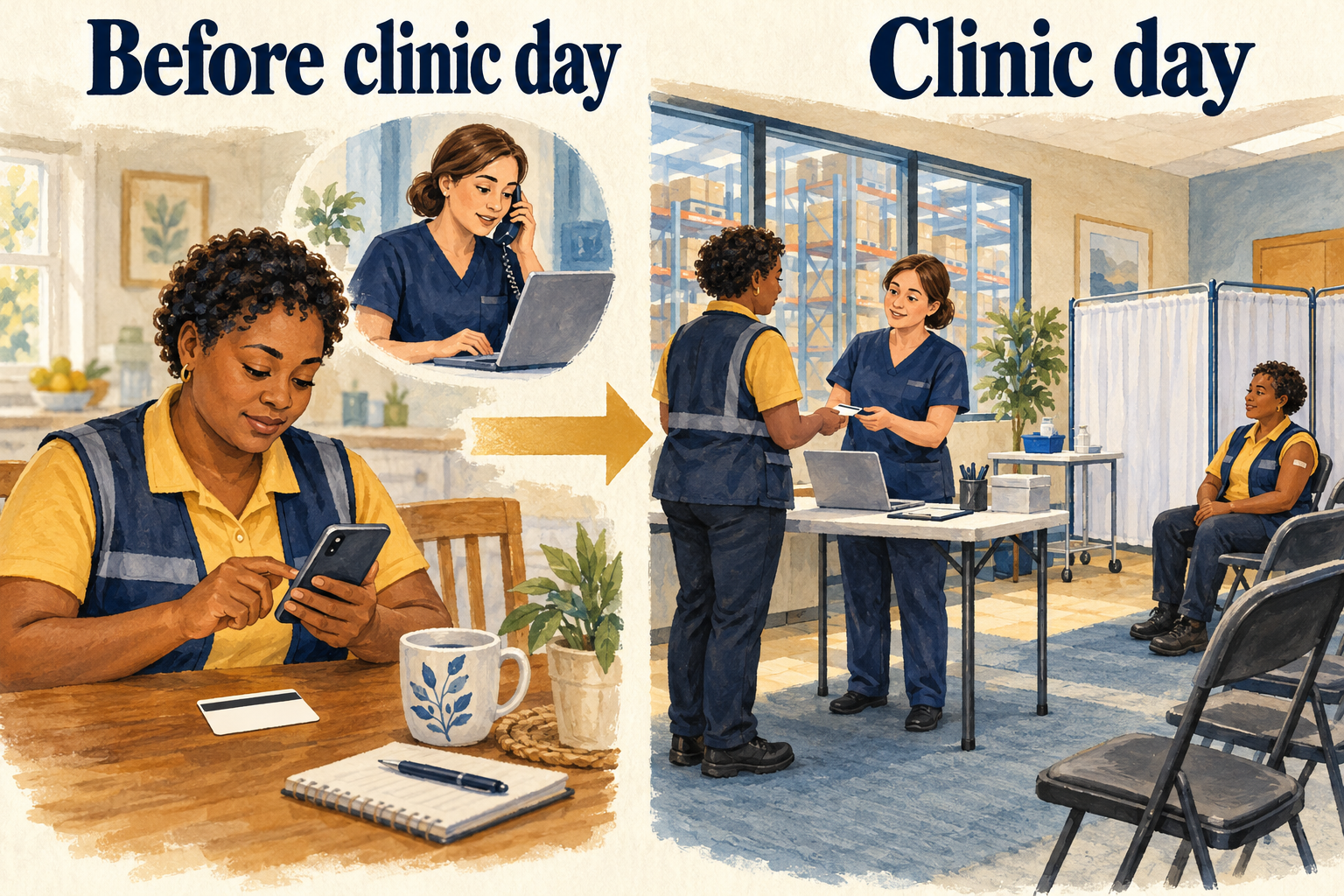
- Invite employees to register. Give them the clinic link, who the service is for, the location and a contact for questions. Employees choose an appointment, enter their details and insurance, answer screening questions and complete consent online.
- Review the information in FairPath. Staff work from an organized registration rather than collecting separate forms. Check that card details are usable; a plan name alone may not give the billing team enough information.
- Resolve questions before clinic day. Contact employees about missing or unclear details and confirm the applicable coverage and billing route. Leave a follow-up window between registration and the event.
- Confirm the attendance plan. Coordinate staggered visits with the host and tell employees their appointment status, where to go and what to bring, including their insurance card.
This preparation still takes staff time. The gain is organizing routine follow-up with the administrative team instead of repeatedly interrupting the vaccinator while employees wait.
A submitted registration starts the pharmacy's review; it does not mean coverage has already been verified. Online screening and consent prepare the clinical visit, which still includes the pharmacist's assessment and questions on the day.
4. Run a steady session while the workplace keeps moving
A group clinic means a sequence of scheduled visits, not the entire workforce arriving at once. Coordinate appointments around departments and shifts so employees can attend without leaving a whole team short-staffed.
Agree what attendance information the coordinator needs for those logistics. Keep screening answers and insurance records in the pharmacy's workflow.
Three parts of the visit
- Arrival and check-in: confirm the employee's identity and appointment, review changes and direct them to the clinical team.
- Clinical care: complete the assessment, answer questions and administer the appropriate vaccination with privacy.
- Observation and return: provide the required observation and complete the visit before the employee returns to work.
Assign routine check-in and administrative help so the vaccinator can stay focused on patients. As one employee moves into care, another can arrive and others can complete observation. Set the arrival rate around the staff and space supporting the whole visit, not just the time needed for an injection.

Keep exceptions from becoming everyone's delay
If an employee brings a different insurance card or needs help with registration, have a staff member assist away from routine check-in. Questions affecting whether care can proceed still need to be resolved before vaccination, but that assistance should not stop every scheduled arrival.
Decide how to handle walk-ins beforehand. An unregistered employee needs the same information review and clinical assessment. Fit them in when the team can complete that work and has capacity; otherwise offer a pharmacy appointment or another clinic opportunity.
The CDC's clinic-planning guidance is a useful reference for staffing, storage, screening, observation and emergency preparation. Organize the work around the care. Removing avoidable gaps and interruptions makes the session more productive without cutting necessary care short.
5. Follow completed services through to collection
The business work continues after the last employee leaves. Accurate clinical records, correct claims or employer invoices, and follow-up are what connect the delivered service to payment.
FairPath connects registration and signed consent with the vaccination record, which can be previewed, printed or saved together. CareCascade also sets up the supported connection to the pharmacy's software through a direct integration or automation bot. Registration information moves through the agreed workflow rather than being retyped from paper.
The pharmacy reviews the records and submits claims or employer invoices through its billing process. Collecting information does not itself submit or settle a claim.
Keep three counts distinct:
- Booked: employees on the schedule, including those who may cancel or miss the visit.
- Completed: vaccinations actually administered and documented.
- Collected: payments received for the services delivered.
Reconcile appointments against the actual service record. Assign responsibility for missing documentation, rejected claims, payment questions and outstanding invoices. Follow each item through correction or resolution rather than leaving it behind when the clinical team moves to the next event.
Those distinctions show where the next improvement belongs. Missed appointments point toward attendance and scheduling; unfinished claims point toward administration and billing. A full calendar alone cannot tell you whether the clinic earned its return.
6. Turn a good event into repeat business
A well-run clinic gives the coordinator a reason to invite your pharmacy back. Employees have had convenient access to care, the workplace has kept functioning and your team knows the venue and preparation involved.
Debrief while the experience is fresh. Ask whether the appointment pattern worked across shifts, whether employees had the information they needed and where the flow slowed down. Discuss a tentative next date rather than waiting for the employer to remember to call. Where a patient needs a later dose or other indicated care, give them a clear follow-up route through the pharmacy.
Review the return, then choose the next step
Look at completed vaccinations, collections, vaccine and supply costs, and total staff time. Compare completed vaccinations and collections per staff hour, counting preparation, travel and billing follow-up as well as clinic time. Read those measures together: outstanding claims can make a recent event look weaker before payments settle.
Use that review to decide whether to:
- Repeat: keep the host and format that work, with clearer instructions or a better appointment pattern.
- Adjust: change the session, staffing or registration process where time or attendance was lost.
- Expand: add a suitable shift or location, or ask the coordinator for an introduction to another employer your team can support.
Keep the registration instructions and venue notes so the next clinic builds on an established process. A familiar coordinator and known layout reduce repeated setup work; the clinical plan still reflects the particular service being offered.
Workplace clinics can become a repeatable part of the pharmacy's business because they combine greater community access with organized group care. Reach people where they work, prepare the information in advance, use the session well and collect accurately. That is the business model worth repeating.
Bring your next vaccination clinic to the workplace
Want to turn workplace vaccination into a repeatable service for your pharmacy? CareCascade can help you get the clinic page, advance registration and scheduling in place, with FairPath keeping the patient information and vaccination record connected.
Request a vaccination-clinic walkthrough to see the employee booking experience, your team's view and how the workflow can connect with your pharmacy software. You do not need a clinic date or a detailed plan to start the conversation.