CareCascade for Independent Pharmacies
AI Gives Independent Pharmacies a Chance to Compete With the Chains
The chains have scale. Independent pharmacies have relationships. AI finally gives local teams a practical way to compete on both.

Independent pharmacies have always had something the chains cannot manufacture: real relationships with patients.
You know the families. You know the local prescribers. You know who needs extra help, who cannot make it in before closing, and who is calling because they are confused rather than impatient.
What the chains have is scale.
They have call centers, software teams, analysts, centralized operations, automated outreach, and people whose entire job is making sure work moves from one system to the next. An independent pharmacy often has the owner, pharmacist, and technician doing all of that while also filling prescriptions and taking care of patients.
That is the opening AI creates.
For the first time, an independent pharmacy can build serious operational horsepower without becoming a giant corporation. AI can watch the inbox, follow up on requests, send messages, place calls, connect systems, organize exceptions, and make sure routine work actually gets finished.
The opportunity is simple: use AI to compete with the chains on efficiency while beating them where independents already win: trust, judgment, and personal service.
But CareCascade is not asking you to become an AI expert. We are not handing you software, teaching you prompts, and leaving you to figure out the rest.
CareCascade is a full-service partner. You bring us the process that is wasting time or frustrating your team. We handle the technology: mapping the workflow, connecting the systems, configuring Buffaly, testing the result, and improving it with you. Your team does not need to build agents, manage integrations, or struggle to learn another complicated platform.
The Chains' Advantage Is Mostly Operational
A chain does not necessarily serve a patient better. It often moves administrative work better.
A refill request lands in a system. A reminder goes out. A call is queued. A task changes hands. A report shows what is late. The organization has enough technology and staff to keep pushing the work forward.
At an independent pharmacy, the same work may live in an inbox, on a sticky note, in a voicemail, inside the dispensing system, and in somebody's memory.
That is not a failure of the team. It is a scale problem.
AI gives a small pharmacy another set of hands for the work that follows rules, repeats all day, and steals attention from patients.
What Could Your Pharmacy Hand to AI?
Start with the work your team is tired of chasing:
CareCascade is built by Intelligence Factory, the company behind Buffaly. We use Buffaly to connect those steps into working systems for independent pharmacies and medical practices. Buffaly is our technology; the working relationship is with CareCascade people.
Buffaly is not just a chatbot that writes an answer. It can use approved tools to read an inbox, create a task, send an email, send a text, place a configured call, check a system, wait for a response, and escalate the exceptions.
That is the difference between talking about the work and doing the work.
A real workflow
Imagine a Transfer Request at 4:45 p.m.
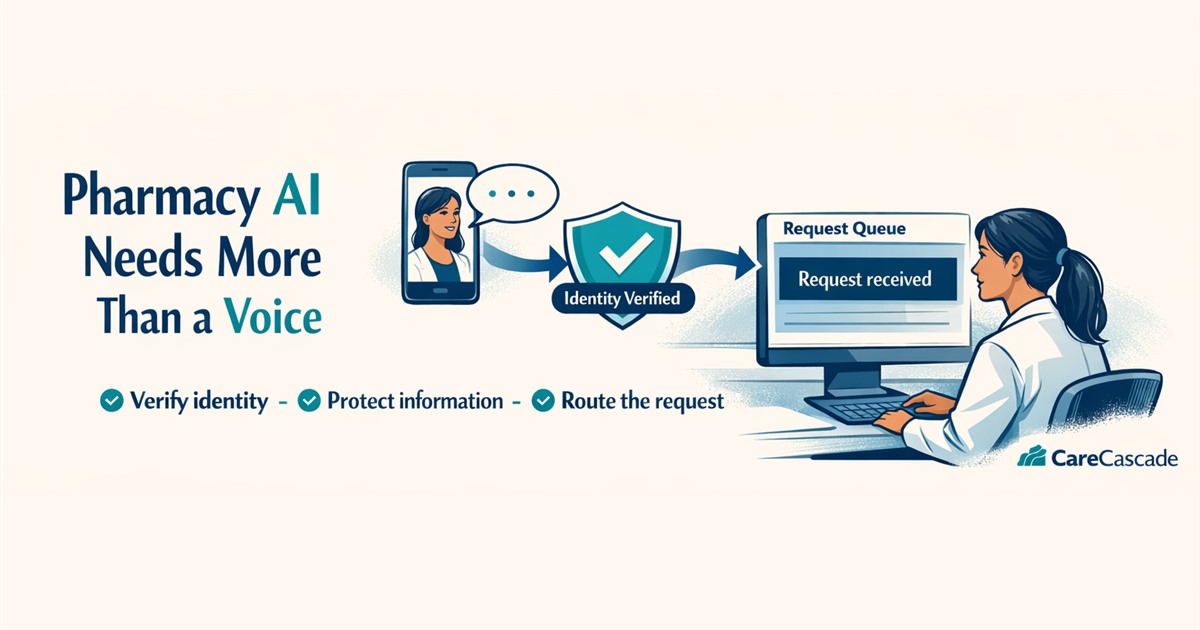
A patient submits a prescription-transfer request through your website near the end of the day.
Today, somebody may need to notice the form, check the information, enter it elsewhere, tell another employee, contact the patient, and remember to look again tomorrow. Every handoff creates another chance for delay.
A Buffaly workflow can:
- 1Check the intake
Confirm whether the required information is present.
- 2Acknowledge the request
Use language your pharmacy has approved.
- 3Create the work
Put it in the system or queue your team already uses.
- 4Keep it moving
Notify the right employee, check the next step, and escalate if it is still sitting there.
That is how a small team starts operating with the follow-through of a much larger organization.
Email, Text, and Phone Should Be One Workflow
Most pharmacies already have email, texting, phones, forms, and internal systems. The problem is that each tool lives in its own world.
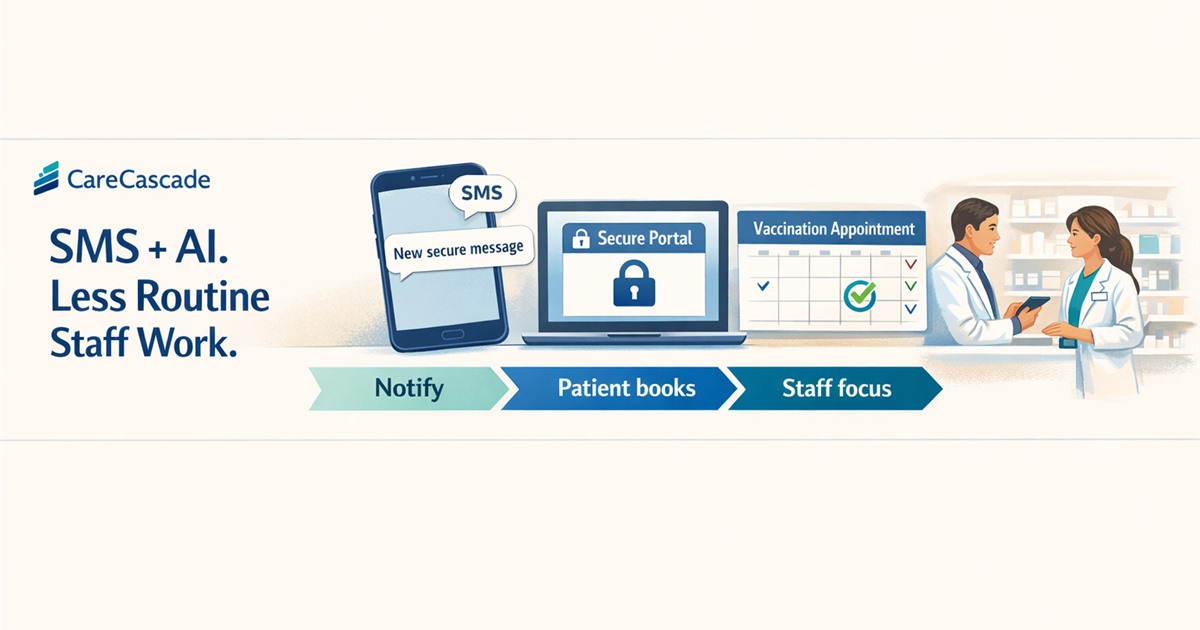
An email gets answered, but no task gets created. A text goes out, but nobody checks for a response. A call fails, but the callback list never changes. The pharmacy has plenty of communication and not enough coordination.
One request. One history. One next step.
AI Can Give the Owner Visibility, Too
The value is not limited to messages.
Buffaly can build a daily operating view that answers questions owners and managers constantly have:
- Which requests are still open?
- Which patients are waiting for callbacks?
- Which deliveries have an exception?
- Which messages failed?
- Which items are waiting for pharmacist review?
- Which promises have not been completed?
Instead of asking three employees and checking four systems, the owner can see where work is stuck and who needs help.
That kind of visibility is normal inside a large operation. AI can make it practical for an independent pharmacy.
Buffaly Gets Better as Your Pharmacy Teaches It
Many AI tools start from zero every time. You explain the task, get an answer, and repeat the same explanation tomorrow.
Buffaly can preserve a successful procedure as a reusable skill.
Once your pharmacy establishes the right process for a transfer request, unanswered message, delivery confirmation, claims review, or daily follow-up list, Buffaly can remember how the work should move. Stable steps can become predictable software actions. Exceptions can still go to people.
Your pharmacy is not merely renting another chatbot conversation. It is building operational capability that reflects how your team works.
You Do Not Need to Replace Everything
Independent pharmacies have already invested in dispensing, point-of-sale, messaging, delivery, scheduling, payer, and document systems. The answer is not necessarily to throw them away.
Buffaly can work between existing systems when they provide a secure, authorized way to connect. CareCascade starts with the workflow, identifies the available access, and builds around the tools the pharmacy already depends on.
Some systems will connect easily. Others may require custom work, vendor cooperation, or a different approach. We confirm that before promising an outcome.
Trustworthy by design
The Pharmacist Still Controls the Pharmacy
AI should take repetitive administrative pressure off the team. It should not practice pharmacy.
People remain responsible for
- Dispensing decisions and final verification
- Medication counseling
- Therapy, interaction, and side-effect questions
- Substitutions and drug-utilization decisions
- Safety concerns and urgent statements
- Complaints, privacy incidents, and ambiguous exceptions
The pharmacy approves
- Which systems Buffaly may use
- Which actions it may take
- Which messages it may send
- Where the workflow must stop
- Which exceptions require a person
Automated text and phone outreach requires documented consent, honored opt-outs, calling-hour and frequency limits, and a process for wrong-party contact.
Buffaly can keep private values behind controlled actions instead of sending every value to an outside AI model. That design alone does not make a workflow HIPAA compliant. Before protected health information is used, the pharmacy and CareCascade must review every participating service, access control, hosting arrangement, and required contract, including business associate agreements where applicable.
Those safeguards matter. They should make the system trustworthy, not turn the entire project into a compliance lecture.
The CareCascade model
Full Service, Not Software and Good Luck
Do not begin with an "AI transformation." Begin with the process your team complains about every week.
Maybe it is the transfer inbox. The callback list. Delivery coordination. Reminder calls. Claims exceptions. A report somebody rebuilds by hand every morning.
You explain that process to a person at CareCascade. We map it with your team, identify where it stalls, confirm which systems can connect, define the permissions and human-review points, and configure Buffaly around the real workflow.
We do the technical work. We build and test the connections, configure the workflow, and stay involved while it improves. Your team does not need to learn prompting, agent design, or automation architecture. The first version can run in observation or approval mode so your staff can see what it would do, correct the exceptions, and approve the steps that are ready for automation.
You do not need to buy an AI project. You need a business problem solved.
Measure whether it worked
- Did staff touch the request fewer times?
- Did it finish faster?
- Did fewer items disappear between shifts?
- Did patients need to call back less often?
- Did pharmacists get interrupted less?
If the workflow does not make the pharmacy calmer, faster, or more reliable, it is not the right automation.
Compete on Efficiency.
Win on Relationships.
The chains will keep spending on technology. Independent pharmacies should not have to surrender the future to them.
AI gives an independent pharmacy the chance to operate with more consistency, visibility, and follow-through while remaining local, accountable, and personal.
Let the chains keep their call centers.
Give your team systems that make sure the work gets done, then let your pharmacists spend more time doing what the chains struggle to copy: knowing and caring for the patient in front of them.
Start with one frustrating process
Show a CareCascade person where the work breaks down.
We will help you determine whether it is a good first candidate for a full-service workflow. You keep talking to patients. We handle the technology behind the scenes.
Talk to a person at CareCascadePlease do not include patient names, prescription details, or other protected health information in the contact form.